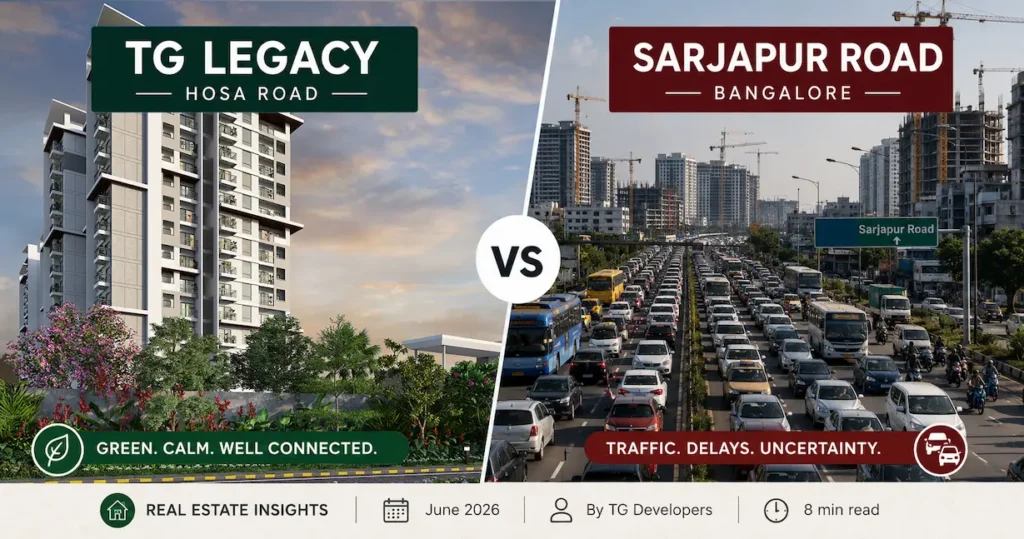
TG Legacy Hosa Road vs Sarjapur Road apartments comparison Bangalore 2026
Sarjapur Road has been Bangalore’s most talked-about residential corridor for a decade. The name alone carries a weight that influences buyer decisions. But in 2026, a growing number of the city’s most informed buyers are making a different call — and the numbers behind that call are compelling. This is not a marketing pitch. It is a comparison.

A NOTE ON HONESTY
We will be transparent in this article. TG Legacy is a TG Developers project. We have an interest in you knowing about it. But the facts we present — about pricing, traffic, infrastructure timelines, and connectivity — are verifiable. We would rather give you an accurate picture and earn your trust than oversell and lose it. Read this, check the facts, and make your own call.

At a Glance: The Full Comparison

Everything that matters to a 2026 home buyer in South Bangalore, side by side.
FactorTG Legacy — Hosa RoadPremium Projects — Sarjapur Road
2 BHK Entry PriceFrom ₹1.30 Cr (1,240 sft)From ₹1.65 Cr – ₹2.0 Cr+
3 BHK Entry PriceFrom ₹1.45 Cr (1,465 sft)From ₹2.0 Cr – ₹3.0 Cr+
Price Per Sft (approx.)₹9,500 – ₹10,500₹11,000 – ₹14,000+
Electronic City Access15 minutes via Hosur Road25–40 minutes (traffic-dependent)
Sarjapur Road Access20 minutes via connecting roadsOn the corridor (but gridlocked)
Metro StationHosa Road Junction (Yellow Line)Upcoming — 5+ years to completion
Metro Construction ImpactAway from metro construction zoneActive construction congestion on corridor
Traffic CongestionLow — multiple connecting roadsSevere — single artery dependency
Feeder Road QualityWide, accessible connecting roadsNarrow internal feeder roads in most pockets
Open Space in Project70% open space (TG Legacy)Varies — often 30–50% in dense projects
Common WallsNo common walls — 3-side ventilationCommon walls standard in most projects
RERA StatusRegistered — PRM/KA/RERA/007663Varies by project
Land Supply RemainingConstrained — fast-appreciatingVery limited — prices have plateaued
Infrastructure TimelinePRR access (2 mins) — near-term15+ years for full infra development
EMI Advantage (3 BHK)*~₹15,000 – ₹25,000 lower per monthHigher EMI due to entry price premium

First, Let's Be Fair — Why Sarjapur Road Has the Reputation It Has
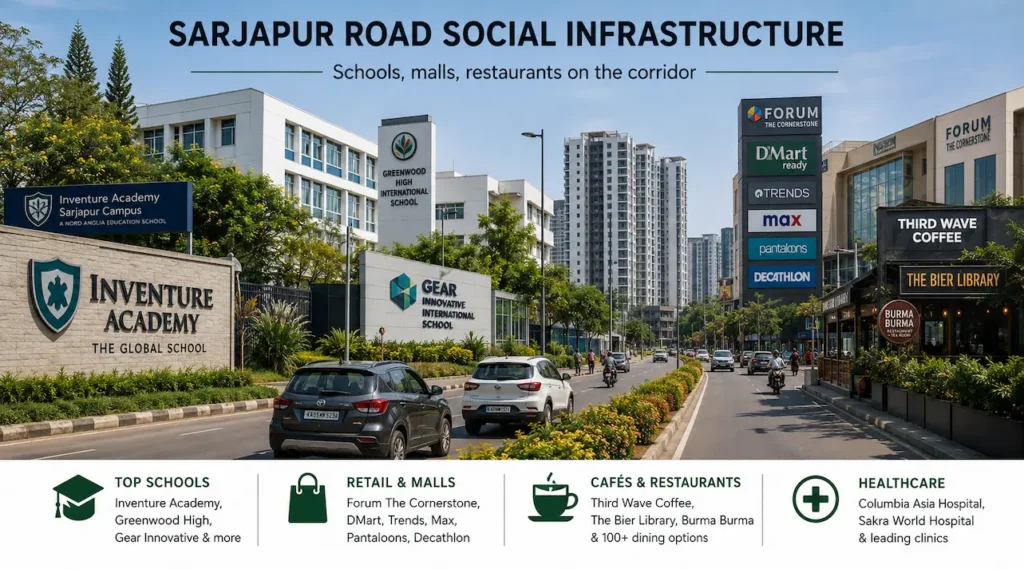
Before we make a case for anything, intellectual honesty requires acknowledging what Sarjapur Road gets right. Because it gets some things genuinely right — and that is why buyers have been drawn to it for years.
Sarjapur Road is a mature corridor. Schools of the calibre of Inventure Academy, Greenwood High, and Gear Innovative International School are located here. The retail and F&B ecosystem — from DMart to premium cafes and restaurants — is fully developed. The social infrastructure that new corridors take a decade to build already exists here. For a family relocating from another city or transitioning from a rented apartment, this maturity is genuinely valuable.
The employment hub proximity is real. RGA Tech Park, EcoSpace, Cessna Business Park, and the Embassy Golf Links tech park ecosystem sit along or adjacent to Sarjapur Road. For a senior professional with a 9 AM meeting and zero tolerance for commute uncertainty, the proximity to these parks has historically been a compelling argument.
We acknowledge all of that. And we still think the comparison, when done properly, tells a different story for most buyers.

The Pricing Gap: ₹55 Lakhs to ₹1.2 Crore in Absolute Difference

This is where the comparison begins to shift decisively. Sarjapur Road’s reputation premium has been fully priced into its property values. What you are paying for on Sarjapur Road in 2026 is not just a home — it is a decade of demand, a recognisable address, and the infrastructure that took years to build. All of that has a cost.
A comparable 3 BHK apartment (1,400–1,600 sft) from a credible developer on Sarjapur Road today costs between ₹2.00 Cr and ₹2.80 Cr. The same configuration at TG Legacy on Hosa Road costs between ₹1.45 Cr and ₹1.60 Cr.
Configuration TG Legacy Price Sarjapur Rd (comparable) Difference Monthly EMI Saving*
2 BHK ~ 1,240 sft ₹1.30 Cr ₹1.65 – ₹1.90 Cr ₹35 – 60 L less ~₹27,000 – ₹46,000/mo
3 BHK ~ 1,465 sft ₹1.45 Cr ₹2.00 – ₹2.40 Cr ₹55 – 95 L less ~₹42,000 – ₹73,000/mo
3 BHK ~ 1,615 sft ₹1.60 Cr ₹2.30 – ₹2.80 Cr ₹70 – 120 L less ~₹54,000 – ₹92,000/mo
What does that EMI difference actually mean for a family? It means a 3 BHK buyer choosing TG Legacy over a comparable Sarjapur Road project frees up ₹40,000 – ₹70,000 per month in disposable income. Over five years, that is ₹24 – 42 lakhs in undeployed capital — money that could fund a child’s education, build an emergency corpus, or be reinvested entirely. The address may cost less. The life it funds does not.

THE PRICE-PER-SFT REALITY
Many buyers focus on per-sft pricing without looking at absolute price. A Sarjapur Road project at ₹10,500/sft sounds comparable to TG Legacy. But when the minimum saleable area on Sarjapur Road is 1,800–2,000 sft (with many developers refusing to offer sub-1,500 sft configurations), the absolute cost of entry is significantly higher. TG Legacy offers 1,240 sft 2 BHK configurations at ₹1.30 Cr — a genuinely accessible entry for a first-time homebuyer that Sarjapur Road does not offer at comparable quality.

“You are not just buying a home on Sarjapur Road. You are paying for everything that happened there before you arrived.”

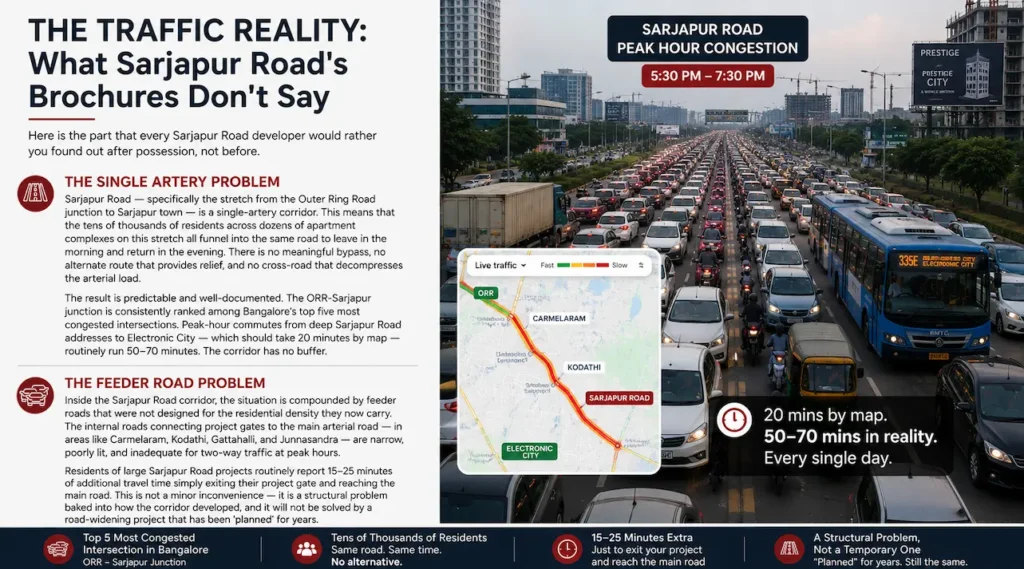
The Traffic Reality: What Sarjapur Road's Brochures Don't Say

Here is the part that every Sarjapur Road developer would rather you found out after possession, not before.

The Single Artery Problem

Sarjapur Road — specifically the stretch from the Outer Ring Road junction to Sarjapur town — is a single-artery corridor. This means that the tens of thousands of residents across dozens of apartment complexes on this stretch all funnel into the same road to leave in the morning and return in the evening. There is no meaningful bypass, no alternate route that provides relief, and no cross-road that decompresses the arterial load.

The result is predictable and well-documented. The ORR-Sarjapur junction is consistently ranked among Bangalore’s top five most congested intersections. Peak-hour commutes from deep Sarjapur Road addresses to Electronic City — which should take 20 minutes by map — routinely run 50–70 minutes. The corridor has no buffer.

The Feeder Road Problem

Inside the Sarjapur Road corridor, the situation is compounded by feeder roads that were not designed for the residential density they now carry. The internal roads connecting project gates to the main arterial road — in areas like Carmelaram, Kodathi, Gattahalli, and Junnasandra — are narrow, poorly lit, and inadequate for two-way traffic at peak hours.
Residents of large Sarjapur Road projects routinely report 15–25 minutes of additional travel time simply exiting their project gate and reaching the main road. This is not a minor inconvenience — it is a structural problem baked into how the corridor developed, and it will not be solved by a road-widening project that has been ‘planned’ for years.
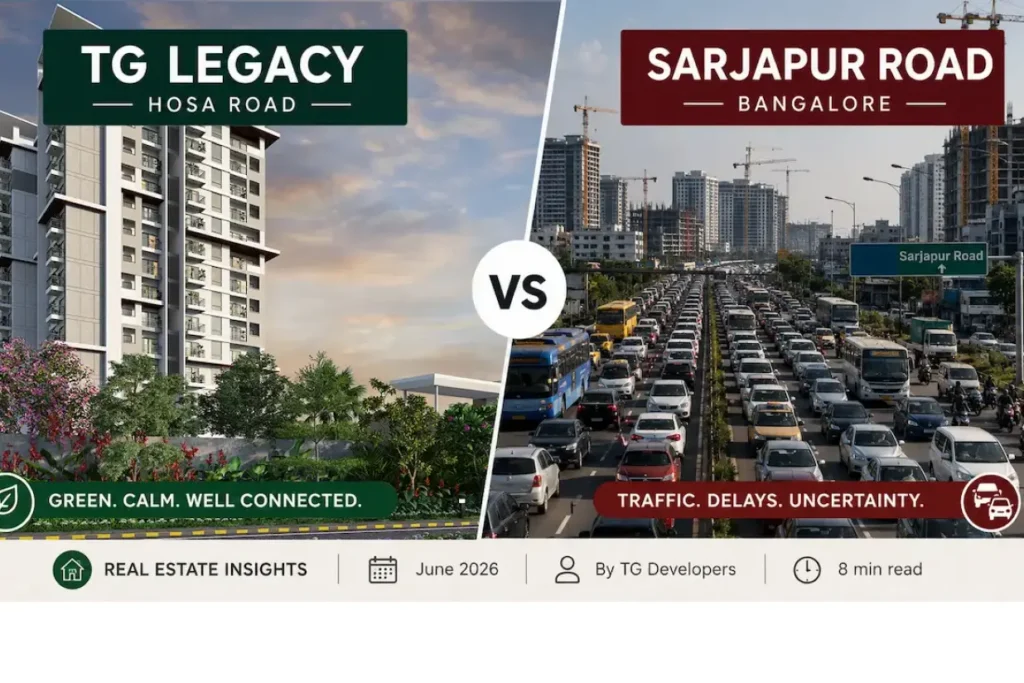
Sarjapur Road Bangalore traffic congestion peak hour 2026

Hosa Road: The Decompressed Alternative

Hosa Road does not have this problem — and the reason is structural, not coincidental. The corridor has multiple connecting roads that distribute traffic across several access points rather than funnelling it through one. Residents of TG Legacy report commute times to Electronic City of 12–18 minutes consistently, including during peak hours.
The difference is not marginal. In a city where the average Bangalore professional spends 43 minutes commuting each way — one of the highest in India — a corridor that saves 30 minutes daily saves 180 hours per year. That is more than seven full days handed back to you, every year, simply by choosing the right address.

✓ TG Legacy — Hosa Road

  • Multiple connecting roads — no single point of failure
  • Consistent 15-min Electronic City commute
  • 12–18 min actual peak-hour travel (resident reported)
  • No dependency on one arterial road
  • Away from metro construction disruption zones

✗ Sarjapur Road — Key Concerns

  • Single arterial road — entire corridor uses one exit
  • 50–70 min Electronic City commute at peak hours
  • 15–25 mins to exit project gate to main road
  • Narrow feeder roads in most project pockets
  • Metro construction will add years of congestion

The Metro Argument: Don't Confuse 'Upcoming' with 'Near-Term'

Both corridors reference metro connectivity in their sales pitch. But the operative word — and one that buyer should scrutinize carefully — is ‘upcoming.’ The timelines, and the disruption they bring, are very different.

Hosa Road Metro: Operational Since August 2025

The Hosa Road metro station is not upcoming. It opened on 11 August 2025 as part of the Yellow Line inauguration by PM Modi. It is running today.
Residents of TG Legacy can walk or take a short auto ride to Hosa Road station and reach Electronic City in two stops — bypassing Hosur Road’s traffic entirely. From RV Road, the Green Line connects onward to the rest of the city’s metro network. Property values near the Yellow Line have already responded — a 10% appreciation has been documented since the line opened. Buyers entering TG Legacy now are entering after the metro is live but before the full appreciation cycle that follows ridership maturity plays out over the next 2–3 years.
Critically: the metro construction disruption is over on this corridor. The metro is built, it is running, and it is not adding a single cone to the road.

Sarjapur Road Metro: Upcoming — But at What Cost?

The metro alignment for Sarjapur Road has been discussed, debated, revised, and reconfirmed over several planning cycles. A Yellow Line extension is planned — but in Bangalore’s infrastructure history, ‘planned’ and ‘delivered’ are separated by years that stretch into decades.
More immediately relevant for a buyer making a decision today: when metro construction does begin on Sarjapur Road in earnest, it will happen on the same arterial road that carries the corridor’s entire traffic load. Every phase of construction — piling, elevated viaduct work, station box excavation — will narrow the already-constrained road and compound the congestion that already makes Sarjapur Road one of Bangalore’s most reported traffic pain points.
Residents who buy on Sarjapur Road today and wait for metro connectivity may find that the years between now and opening day are the most difficult commuting years they experience — not the best ones.

THE INFRASTRUCTURE TIMELINE REALITY
Sarjapur Road has been ‘developing infrastructure’ for fifteen years. The Outer Ring Road widening, the Sarjapur Road widening, the signal-free corridor — each of these projects has been announced, commenced, stalled, restarted, and is still incomplete. The buyers who have lived on Sarjapur Road through this period have experienced the development as a process, not a promise delivered. When a Sarjapur Road developer says ‘upcoming infrastructure,’ ask them for the BBMP or BMRCL timeline — and then apply a realistic multiplier to whatever date they give you.

“Metro connectivity is valuable. Metro construction is not. Know which one you are buying into.”

Connectivity Without the Corridor: The Hosa Road Advantage
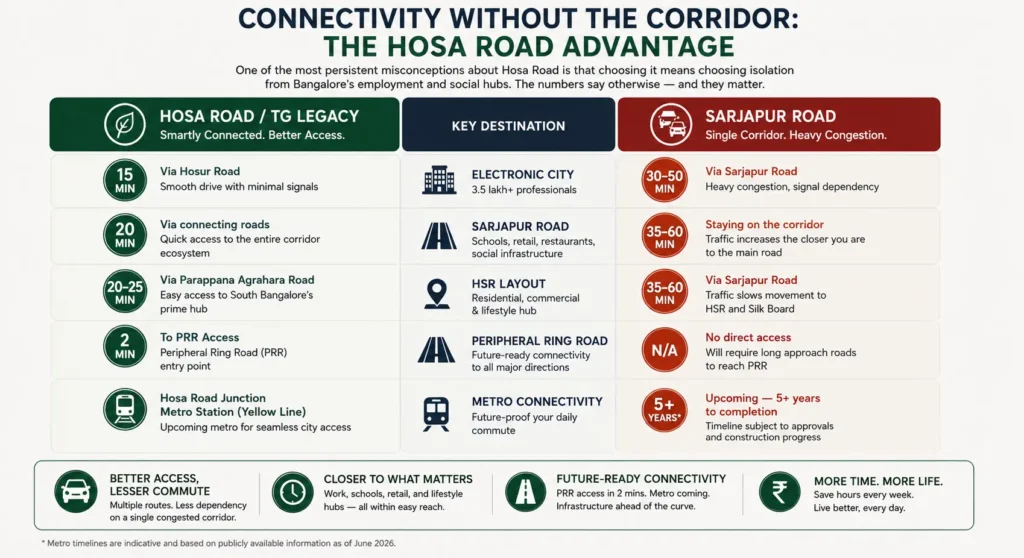
One of the most persistent misconceptions about Hosa Road is that choosing it means choosing isolation from Bangalore’s employment and social hubs. The numbers say otherwise — and they matter.
Hosa Road vs Sarjapur Road connectivity comparison Bangalore Electronic City PRR metro

Electronic City: 15 minutes from TG Legacy via Hosur Road. For the 3.5 lakh+ professionals working here, this is the commute that defines daily quality of life. From deep Sarjapur Road, the same destination — which sits on the opposite side of the corridor — takes 30–50 minutes with signal dependency and peak-hour congestion.

Sarjapur Road Itself: 20 minutes from TG Legacy via the connecting road network. This is the point that often surprises buyers who assume Hosa Road means losing access to Sarjapur Road’s ecosystem. The schools, retail, and social infrastructure of Sarjapur Road are accessible from Hosa Road without the buyer having to live on the corridor and deal with its congestion daily.

HSR Layout: 20–25 minutes from TG Legacy. One of South Bangalore’s most sought-after residential and commercial hubs.

Peripheral Ring Road: 2 minutes from Hosa Road. When the PRR becomes operational, Hosa Road residents will be able to reach Whitefield in under 25 minutes and Tumkur Road in under 40 — without using a single signal-heavy arterial road. No Sarjapur Road address offers this.

The 15-Year Infrastructure Wait — and What It Costs in Quality of Life

Sarjapur Road’s infrastructure story is familiar to anyone who has followed Bangalore’s real estate market. The stories are consistent across a decade and a half: the road widening that was promised in 2012, commenced in 2015, paused in 2018, restarted in 2021, and remains incomplete. The signal-free corridor that was approved in two consecutive BBMP budgets and not delivered in either. The stormwater drains that still flood during heavy rain in areas that have had 10,000+ residential units added since the last major infrastructure upgrade.
This is not a criticism of the corridor’s long-term potential. Sarjapur Road will, eventually, have the infrastructure its density demands. But ‘eventually’ has consistently meant ‘later than promised’ in Bangalore’s infrastructure history. A buyer who moves into a Sarjapur Road project today on the assumption that infrastructure will improve materially within 5 years should weigh that assumption against a 15-year track record of partial delivery.
Hosa Road does not carry this overhang. The corridor’s development phase has been more measured, the infrastructure more proportionate to current density, and the upcoming additions — PRR access, metro — are funded, confirmed, and closer to delivery than any Sarjapur Road infrastructure project currently in progress.
THE HONEST QUESTION FOR SARJAPUR ROAD BUYERS Ask the developer you are evaluating: ‘What is the current state of the roads, drains, and power supply around this project, and what infrastructure is confirmed for delivery in the next three years?’ The answers will tell you more than any brochure.

What TG Legacy Actually Offers — Beyond the Location
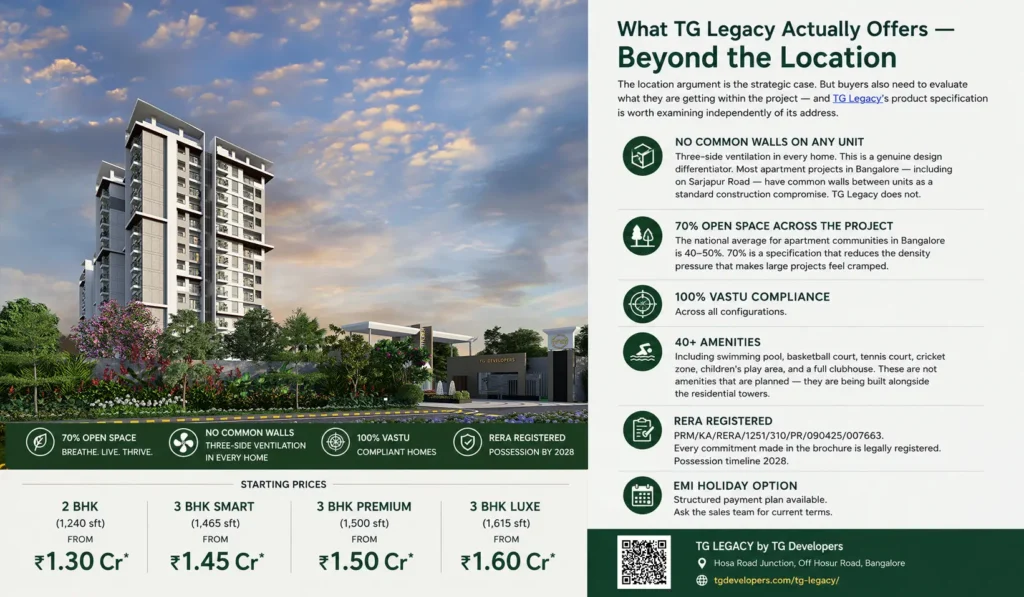
The location argument is the strategic case. But buyers also need to evaluate what they are getting within the project — and TG Legacy’s product specification is worth examining independently of its address.
TG Legacy 2 BHK 3 BHK apartments Hosa Road Sarjapur Road Bangalore by TG Developers

The Honest Answer: Who Should Buy Where

We said at the start that this would be an honest comparison. Honesty requires acknowledging that Sarjapur Road is the right answer for some buyers — even in 2026.

Choose Sarjapur Road if:

  • You work in one of the specific tech parks on the corridor (EcoSpace, Cessna, RGA) and have zero flexibility on commute time
  • Your children are enrolled in schools on Sarjapur Road and relocating them is not an option
  • Budget is not a constraint and the address premium is a genuine priority for you
    You are a seasoned investor comfortable waiting 8–10+ years for full infrastructure maturity

Choose TG Legacy on Hosa Road if:

  • You work in Electronic City, HSR Layout, Koramangala, or any tech park accessible from the south Bangalore corridor
  • You have a family and want more space, better air circulation, and lower density than most Sarjapur Road projects offer
  • You are a first or second home buyer and the EMI difference of ₹30,000–₹70,000 per month matters to your financial planning
  • You want to own before the PRR and Hosa Road metro go operational — and capture the appreciation those infrastructure events will deliver
  • You are an investor with a 5–7 year horizon who understands that pre-infrastructure corridors with constrained supply have consistently outperformed mature corridors in Bangalore’s appreciation cycles
“The best address is not the most famous one. It is the one that fits the life you are actually living — and the one that grows with it.”

Explore TG Legacy — The Hosa Road Alternative

2 & 3 BHK from ₹1.30 Cr · RERA Registered · 40+ Amenities · Site Visits 7 Days a Week

Frequently Asked Questions

Is TG Legacy really cheaper than Sarjapur Road apartments?
Yes, significantly so in absolute terms. A 3 BHK at TG Legacy starts at ₹1.45 Cr for 1,465 sft. A comparable 3 BHK from a credible developer on Sarjapur Road starts at ₹2.00 Cr and can go up to ₹2.80 Cr. The difference — ₹55 lakhs to ₹1.35 Cr — translates to a monthly EMI saving of ₹42,000 to ₹1,03,000 at current home loan rates.
Yes. TG Legacy is approximately 20 minutes from the Sarjapur Road junction via connecting roads. This gives residents access to Sarjapur Road’s schools, retail, hospitals, and social infrastructure without living on the corridor and dealing with its daily traffic
15 minutes via Hosur Road under normal traffic conditions. This is consistent even during peak hours due to Hosa Road’s multiple connecting road access points that prevent single-artery congestion. By contrast, commutes from deep Sarjapur Road to Electronic City can run 50–70 minutes at peak hour.
Sarjapur Road is a single-artery corridor — the entire residential population of the stretch, which has added over 50,000+ apartment units in a decade, exits through the same road at the same time. The Outer Ring Road junction is one of Bangalore’s most congested intersections. Internal feeder roads connecting projects to the main road are narrow and unable to handle density. Infrastructure improvements have been planned but consistently delayed across multiple BBMP budget cycles.
Metro connectivity will provide an alternative to road travel once operational — but that is likely 7–10+ years away. More immediately, metro construction on Sarjapur Road itself will narrow the already-constrained arterial road during the construction phase, which could worsen traffic for the years between groundbreaking and opening. Buyers need to factor in the construction period, not just the eventual benefit.
Yes. TG Legacy is RERA registered under PRM/KA/RERA/1251/310/PR/090425/007663. Possession is targeted for 2028 as per the registered timeline. All commitments — including layout, amenities, and unit specifications — are legally registered with Karnataka RERA.
Hosa Road has near-term infrastructure additions — PRR access within 2 minutes and a metro station at Hosa Road Junction on the Yellow Line — both of which are funded and confirmed. Sarjapur Road’s infrastructure improvements, including road widening, signal-free corridors, and metro connectivity, have been in planning for over a decade with inconsistent delivery timelines. Realistic full infrastructure completion on Sarjapur Road is 15+ years away.

The Last Word

Sarjapur Road is not a bad choice. It is an expensive, congested, over-leveraged choice for a buyer who can get more — more space, lower EMI, better commute, equivalent amenities, and superior infrastructure trajectory — by looking 20 minutes to the south.
TG Legacy on Hosa Road is that choice. It is not for buyers who need the address. It is for buyers who want the outcome — a home that is financially sustainable, daily-livable, and positioned to appreciate as the PRR, metro, and supply constraints do their work over the next 5–7 years.
The buyers who choose wisely in 2026 will not be the ones who followed the loudest corridor. They will be the ones who did the comparison — honestly, with real numbers — and made the call that fit their life.

Ready to See TG Legacy for Yourself?

Book a site visit — 7 days a week including Sundays · No commitment required

Tags